
- Part 1: Why Driving Demands 100% of Your Brain (The Primary Task)
- Part 2: The “Sorry, Sorry, Sorry” Trap – When Passengers Hijack Your Purple LIne
- Part 3: Able To Respond – How To Drop Reasons, Emotions & Social Noise
Part 1: The Primary Task — Why Driving Demands 100% of Your Brain
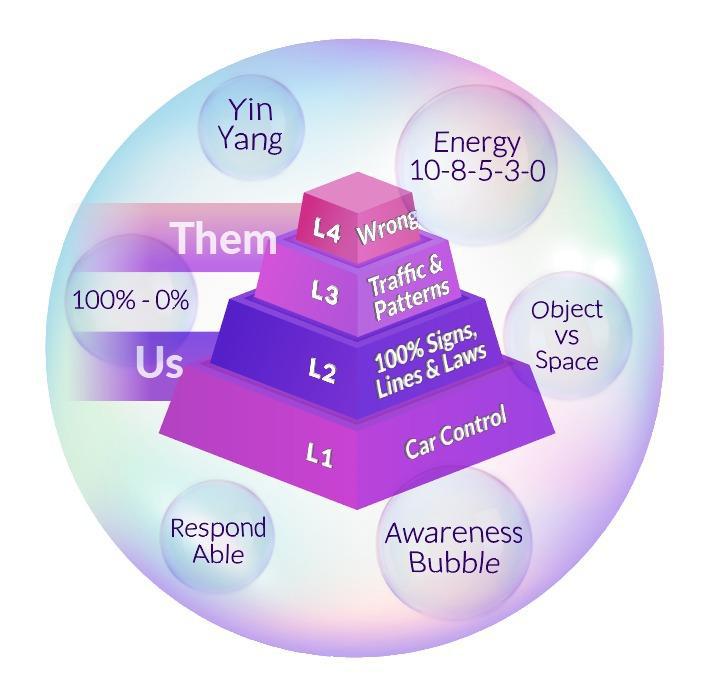
“To truly drive properly, you need full attention, which requires 100% brain and eyes focused on the primary task, that of driving the car. This is the main task, always.” — COOPER
Driving demands the Purple Line vision — constantly scanning around, reading the laws, keeping the car in the right place, and handling endless interactions with other road users, traffic signs, weather, and your own condition that day: fatigue, stress, distractions, worry, deadlines, and life in general.
Recent research shows driving requires over 1,000 skills and is one of the most complex things any human does daily. Of all the tasks in your day, if you measured the risk, driving is the one that opens you up to the most conflict, trouble, money loss, injury, legal issues — even death.
From all my years of training and helping others, the key element is the Purple Line. At its core is this truth: both your eyes and your brain must hold the primary task top of mind all the time — always, always, always.
In the cell phone studies I worked on as lead assessor for Transport Canada with Sue McNeil and Little World Inc., drivers who were seriously affected by cell phones or talking passengers were already in the unsafe group long before the distraction arrived. They were willing to let the new distraction pull them away from the primary task.
Safe drivers showed almost no effect from the same distractions. Why? A safer driver keeps the driving task as the primary focus, top of the pile at all times.
When the phone rang, a passenger talked, a baby cried, they hit a pothole, or faced a strange intersection, ice, or snow — the safe driver stayed locked on: Where is the car? Where are my four wheels? What’s coming up? How do I manage it and protect myself?
They would say, “Sorry, wait a second,” handle the complex part, then come back: “Okay, what were you saying?”
Before cell phones, passengers were the biggest distraction — and they still are. Many places limit young drivers from having groups of friends because the crash rate jumps. It becomes a party. Families with multiple people are often still allowed, but as my clients tell me, that can be an even bigger distraction.
Bear with me here as we dig into this. This is where the real Purple Line work begins.
Article Pulled From The Purple Line Trilogy Cooper is working on which should be published end of 2026. Fingers crossed.
Supporting quotes from sources: “According to ergonomics-based car driving task analysis, more than 45 different tasks are associated with driving to regulate interactions with both the vehicle and the environment.” (from the neuroergonomics meta-analysis)
“Passengers may affect male teen driver crashes through both distraction and risk-promoting pathways, and female involvement primarily through internal distraction.” (from peer passenger study) https://www.jahonline.org/article/S1054-139X(11)00360-0/fulltext


Comments are closed